The ozone layer protects life on Earth from harmful ultraviolet radiation. In the 1980s, scientists found that it was thinning, and the cause was traced to industrial chemicals. Governments agreed to phase them out, and the layer is now on a path to recovery. It is one of the clearest successes of international environmental cooperation.
The story is often told as a simple triumph. It is more useful as a set of lessons about how environmental agreements work.
What the problem was
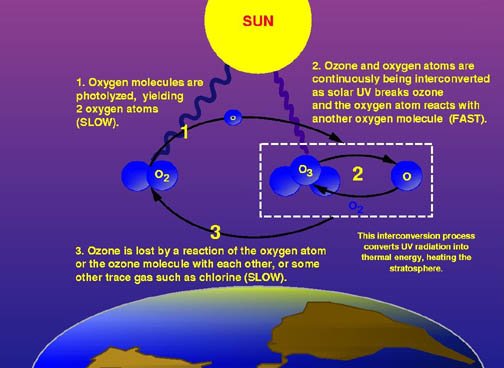
Chlorofluorocarbons and similar chemicals, used in refrigeration, aerosols and foam, released chlorine in the upper atmosphere. Chlorine destroys ozone molecules in a catalytic cycle, so a small amount of chemical can destroy a large amount of ozone. The effect concentrated over the poles, producing the Antarctic ozone hole.
How the response worked
The Montreal Protocol set a schedule for phasing out the chemicals, with different timetables for different countries. It included financial and technical support for developing countries, which made participation possible. Crucially, it was designed to be adjusted as science advanced.
Several conditions helped. Substitutes were available, so industry could adapt. The science was clear and the harm was visible. The agreement was flexible enough to tighten as evidence accumulated. And the costs were concentrated in a few industries, which made them easier to address than diffuse sources.
Climate change involves the entire energy system rather than a handful of chemicals, and the costs of action are spread across every economy. That makes the political problem far harder, even though the underlying logic of cooperation is similar.
Ozone recovery depends on continued compliance and on managing chemicals that were introduced as substitutes and later found to have warming effects. The layer is expected to recover over the coming decades, provided the phase-out holds.
What to watch
The indicators worth following are atmospheric chlorine concentrations, the size of the ozone hole and compliance with the phase-out schedule. Those measurements show whether the recovery is proceeding as projected.
Chemical manufacturers initially resisted the phase-out, and the agreement succeeded partly because substitutes were developed and the costs proved manageable. Industry participation in the negotiations, and the availability of alternatives, turned a confrontation into a transition. That combination is not always available.
Later environmental agreements have borrowed elements of the ozone model: differentiated responsibilities, financial support and periodic review. The model works best where the problem is well defined and substitutes exist, and less well where the sources are diffuse and the costs are widespread.
Recovery is verified through a global network of ground stations and satellites that measure ozone and the chemicals that affect it. Sustaining that network is essential, because without measurement there is no way to know whether the phase-out is working. Monitoring is the unglamorous infrastructure behind a celebrated success.
The role of developing countries
The ozone agreement gave developing countries a longer timetable and financial support, which was essential to participation. That principle, common but differentiated responsibilities, has since become a template in climate negotiations. Its application is harder where the costs of action are spread across the whole economy.
Recovery depends on continued compliance, on the behaviour of substitute chemicals and on the interaction with a warming atmosphere, which changes atmospheric circulation. The projected recovery date carries uncertainty, and monitoring is what will confirm or revise it over the coming decades.
The ozone agreement depended on scientists producing evidence that governments could not dispute and on diplomats turning that evidence into a workable text. The same combination is required for climate, where the evidence is equally strong and the political economy is harder. The lesson is not that the ozone model can be copied wholesale, but that clear science, available substitutes and flexible institutions are what make cooperation possible. Where any of the three is missing, agreements tend to stall, and the delay has a cost measured in the problem getting worse.
Ozone recovery will take decades more, and it depends on decisions already made continuing to hold. The agreement is not finished business. It is a reminder that environmental problems can be solved when the science is clear, substitutes exist and institutions are flexible, and that the same conditions are what climate policy still lacks in part.
The ozone story is often cited as proof that global environmental problems can be solved. It is better read as proof that they can be solved under particular conditions, and that building those conditions elsewhere is the work that remains.
Whether the ozone model can be replicated depends less on the science, which is clear, than on the politics of cost. That is the part the agreement cannot supply, and the part each country has to work out for itself.
This report draws on the UN Environment Programme’s ozone work and the World Meteorological Organization.
Image: NASA/GSFC · Public domain · via Wikimedia Commons.