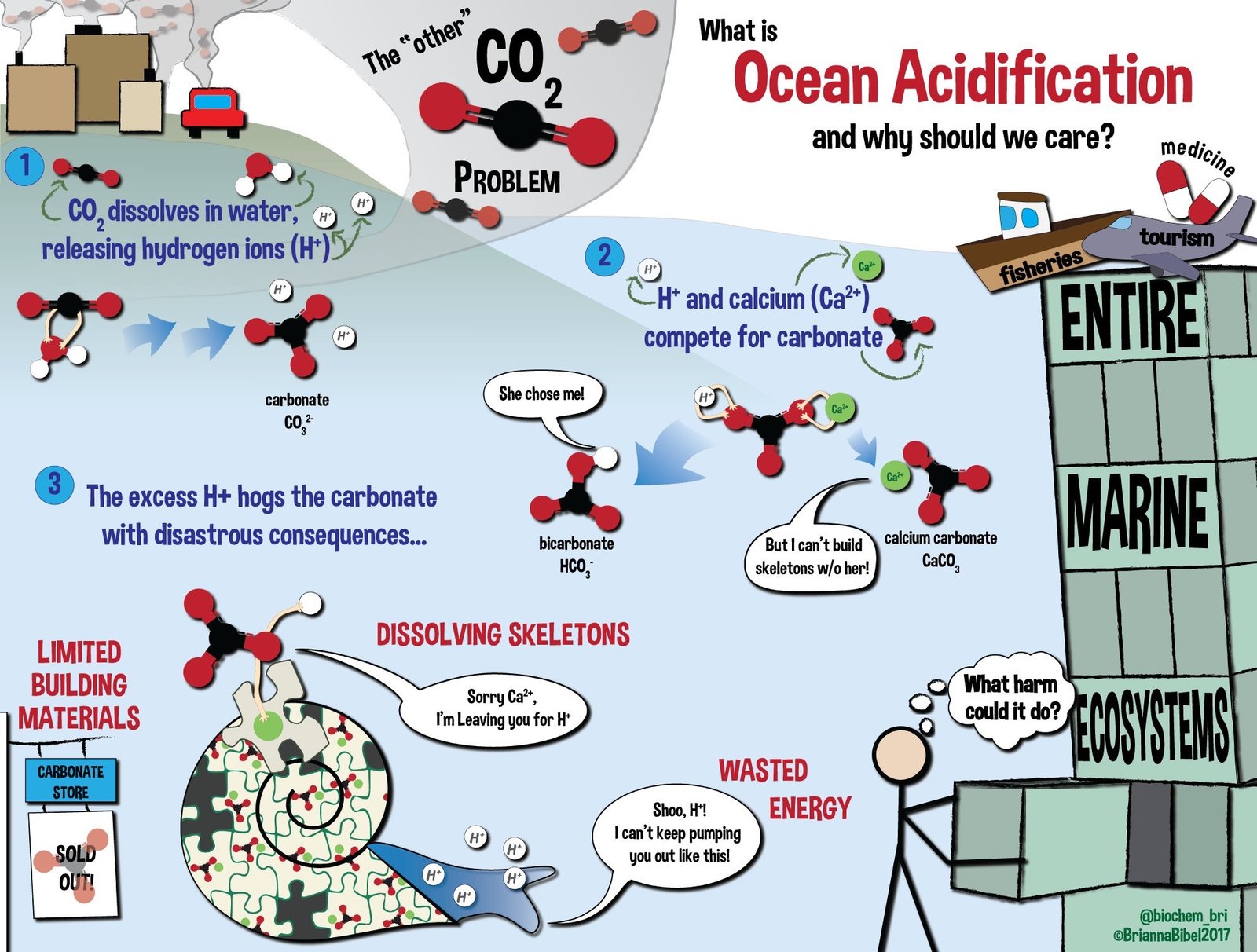
When carbon dioxide enters the atmosphere, a substantial share of it dissolves in the ocean. That absorption has slowed warming and it has changed the chemistry of seawater, making it more acidic. The process is called ocean acidification, and it is a consequence of emissions that receives far less attention than temperature.
The change is measured in fractions of a pH unit, which sounds small and matters enormously to organisms that build shells and skeletons.
The chemistry
Carbon dioxide dissolved in water forms carbonic acid, which releases hydrogen ions. More hydrogen ions mean lower pH, and they also reduce the availability of carbonate, the mineral that many marine organisms use to build shells. The chemistry is well understood and the trend is unambiguous.
Which organisms are affected
Corals, molluscs, some plankton and other calcifying species are directly affected. Their shells and skeletons become harder to build and easier to dissolve. Because these organisms sit near the base of marine food webs, the effects propagate to fish, seabirds and the people who depend on them.
Why it is not the same as warming
Acidification follows directly from carbon dioxide concentrations, not from temperature. A cold ocean can still be acidic, and reducing other pollutants does not address it. This is why it is described as the other carbon problem: the only solution is to reduce carbon dioxide emissions.
The economic stakes
Shellfish farms, coral-based tourism and wild fisheries are all exposed. Some hatcheries already manage water chemistry to protect larvae, which shows that adaptation is possible at a cost. For wild populations, there is no equivalent intervention.
Monitoring and gaps
Ocean chemistry is measured at a limited number of stations, ships and buoys, with coverage concentrated in wealthier regions and the open ocean. Coastal areas, where the effects on livelihoods are most direct, are often poorly monitored. The data gap mirrors the pattern seen in climate science more broadly.
What can be done
Reducing emissions is the only durable response. Locally, reducing nutrient runoff and other stressors can give marine ecosystems more resilience, though it does not change the underlying chemistry. Marine protected areas help with other pressures, not with acidification itself.
Where to look next
The indicators worth following are regional pH trends, carbonate saturation and the condition of shellfish and coral populations. Those measurements, rather than global averages, will show where the effects are appearing first.
Why the issue is overlooked
Acidification is invisible to the eye, slow in onset and difficult to communicate. Unlike a bleaching event, it produces no dramatic image. That makes it harder to fund and easier to defer, which is a recurring problem for environmental issues whose effects accumulate quietly over decades.
The regional pattern
Acidification is not uniform. Cold, deep-water regions and areas with strong upwelling tend to become corrosive sooner, and some coastal seas are affected by local pollution as well as global carbon. That variation matters for fisheries management, because a stock that is healthy in one area may be under pressure in another.
What to watch
The indicators worth following are regional pH trends, carbonate saturation and the condition of shellfish and coral populations. Those measurements, rather than global averages, will show where the effects are appearing first.
This report draws on the National Oceanic and Atmospheric Administration and UNESCO’s ocean science work.
Image: Unidentified NOAA photographer · Public domain · via Wikimedia Commons.