Poverty is often discussed in terms of a single threshold: the international poverty line. That line is useful for comparison and is not the same as poverty itself. The World Bank’s Poverty, Prosperity, and Planet report brings together measures of poverty, shared prosperity, inequality and environmental pressures, and its value lies in showing how much depends on which measure you choose. Changing the line, or the dimension, changes who counts as poor and what policy follows.
What the international poverty line measures
The line is set in terms of daily consumption or income, adjusted for purchasing power across countries. It represents a very low threshold, a subsistence minimum, and it is designed to allow comparison between countries at very different price levels. People below it are described as extremely poor. Because the line is deliberately minimal, it captures only the most severe deprivation, and progress against it can coexist with widespread hardship above it.
Why one line is not enough
Poverty spans a range, and a single threshold captures only its extreme end. Higher lines, for lower-middle and upper-middle income countries, capture people who are poor by the standards of their own societies but above the extreme line. Multidimensional measures add health, education, housing and services. Measures of shared prosperity track whether the poorest are keeping pace with the average. Each answers a different question, and a government that reports only one can look successful on one measure and failing on another.
The difference between poverty and inequality
Poverty is about how low people are; inequality is about how far apart they are. A country can reduce poverty while inequality widens, if growth benefits those above the poorest more than the poorest themselves. This is why the report tracks both. Rising inequality can also slow future poverty reduction, because it shapes access to education, health and opportunity, the very things that allow people to escape poverty in the first place.
Multidimensional poverty
Income is a means, not the whole of well-being. Multidimensional measures count overlapping deprivations: a household may be above the income line yet lack clean water, schooling or adequate housing. Because deprivations cluster, a household that is behind on one dimension is often behind on several. Multidimensional measures reveal people that an income line misses, and they point to different policies, since the remedy for a water gap is not the same as the remedy for a low wage.
How the poor are counted
Poverty figures come from household surveys, which are expensive, periodic and not always comparable across time. Between surveys, estimates are modelled, which introduces uncertainty. In conflict zones and remote areas, data may be missing altogether, so the poorest are sometimes the least counted. Reading a poverty statistic responsibly means knowing when it was collected, how it was estimated and who might be missing from it.
Shared prosperity and the growth question
A recurring finding is that growth reduces poverty most when it reaches the sectors and regions where poor people work. Growth concentrated in capital-intensive sectors or in already-prosperous regions can leave poverty stubbornly high. This is why the report links poverty to the pattern of growth, not just its rate. It also explains why some countries with strong aggregate growth have made little progress against poverty, while others with modest growth have done more.
The environmental dimension
The report’s title signals a third concern: the planet. Climate change and environmental degradation hit poor households hardest, because they depend more on natural resources, live in more exposed places and have fewer means to adapt. This creates a difficult tension: poverty reduction has historically relied on growth that has often been carbon-intensive, yet the climate consequences fall on the poor. Resolving that tension, reducing poverty without locking in environmental harm, is one of the central challenges in development policy.
What follows for policy
If poverty is multidimensional and shaped by growth patterns, the policy response has to be broader than cash transfers, important as those are. It includes investment in basic services, access to education and health, social protection that reaches the poorest, and environmental policies that protect the people most exposed. It also includes attention to inequality, because concentration of opportunity limits how far poverty can fall.
Data gaps and the people who are missed
Poverty measurement depends on surveys that are costly and infrequent, and on models that fill the gaps between them. Where surveys cannot reach, conflict zones, remote areas, some urban informal settlements, the poorest may be invisible, so the headline can understate deprivation precisely where it is worst. Improving the frequency and coverage of data, and using administrative records and mobile surveys to supplement traditional methods, is therefore not a technicality. It determines whether policy is aimed at the people who need it, or only at those who can be counted.
Sources
- World Bank. Poverty, Prosperity, and Planet. worldbank.org
- World Bank. Poverty and Inequality Platform. worldbank.org
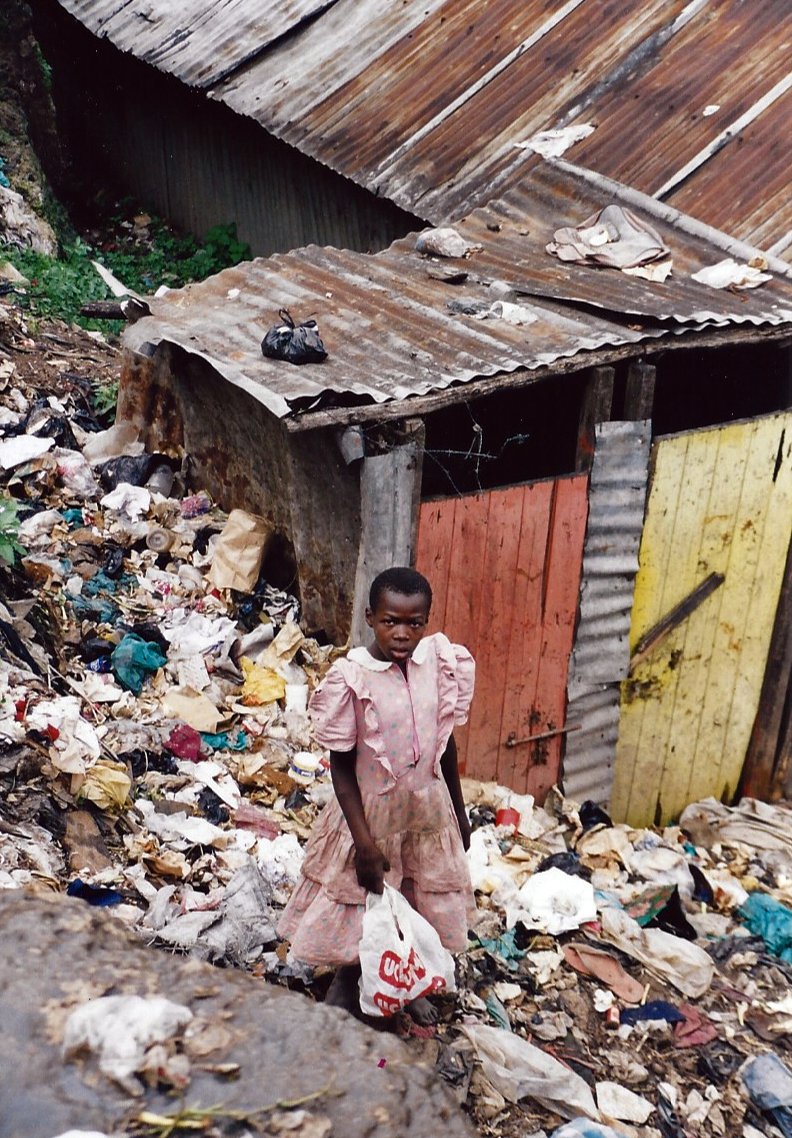
Image: Mostafameraji · CC0 · via Wikimedia Commons.