Social protection covers pensions, health care, unemployment benefits, disability support and cash transfers. It is one of the most effective tools for reducing poverty, and it reaches only a minority of the world’s people. The gap is not mainly a shortage of ideas. It is a shortage of financing and of the administrative systems that deliver benefits.
What the coverage numbers show
International estimates find that a large share of the global population has no access to at least one form of social protection, with coverage lowest in low-income countries and among informal workers. The figure matters because it describes people who are one illness, accident or job loss away from destitution.
Why informality is the core problem
Contributory schemes depend on formal employment, where contributions are deducted and recorded. Where most work is informal, those schemes miss most workers. Extending coverage therefore requires either non-contributory benefits financed from general revenue, or new mechanisms to reach informal workers, or both.
Social protection costs money, and low-income countries collect relatively little tax as a share of national income. Expanding coverage without revenue means either borrowing or reallocating spending. International support can help, and it is small relative to the need. Domestic revenue mobilisation is the long-term answer, and it is slow.
Cash transfers and their effects
Evidence from many countries finds that cash transfers reduce poverty, improve nutrition and school attendance, and do not generally make people work less. The effects are largest when payments are reliable and predictable. The evidence base is strong, and political support for such programmes varies.
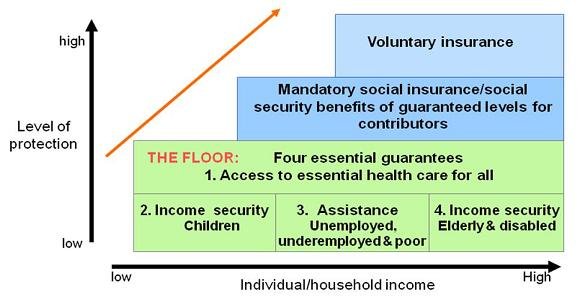
Programmes can be universal, covering everyone, or targeted at the poor. Universal schemes are simpler to administer and avoid exclusion errors; targeted schemes cost less and can miss people. The choice depends on administrative capacity and politics, and the debate is often more ideological than technical.
Shock-responsive systems
Climate disasters and economic crises increase the need for support at exactly the moment when systems are strained. Building the ability to scale up quickly, sometimes called shock-responsive social protection, is a growing area of policy. It requires registers of potential beneficiaries and flexible financing.
Progress is measured in coverage, adequacy and reliability rather than in new programmes alone. A benefit that is too small or paid late does not protect anyone. The practical work is administrative and fiscal, and it is the part that rarely makes headlines.
The role of digital payments
Digital payment systems have made it cheaper and faster to deliver cash transfers, and they reduce leakage and fraud. They also depend on identity documents, mobile coverage and agents, which the poorest may lack. The technology improves delivery where the underlying systems exist, and it cannot substitute for them.
Effective programmes tend to be predictable, adequate and simple to access. Complexity in eligibility rules creates exclusion, because people who cannot navigate the process lose out. The design of the application, rather than the generosity of the benefit, often determines who actually receives support.
The political economy
Social protection creates beneficiaries, which builds political support for its continuation. It also creates costs that finance ministries scrutinise. The durability of a programme depends on whether its support is broad enough to defend it and narrow enough to be affordable. That balance is struck differently in every country.
Programmes that reach people tend to share features: clear eligibility, simple enrolment, reliable payment and a route to appeal. Where any of these is missing, coverage falls even when the benefit exists on paper. Administrative quality is therefore as important as the size of the budget, and it is harder to improve.
The role of international support
International organisations provide financing, technical assistance and evidence on what works. Their contribution is most useful when it strengthens domestic systems rather than creating parallel ones that end when a project does. Sustainability depends on whether programmes are embedded in national budgets and institutions.
Coverage figures improve slowly because they depend on tax capacity and administration rather than on announcements. The countries that have made the most progress have usually built systems over decades, which is a reminder that social protection is a long project rather than a single policy.
A country can report high coverage and still leave people unprotected, because the benefit may be too small or too irregular to matter. Measuring adequacy is harder than measuring coverage, which is why headline figures often flatter the systems they describe. The honest question is not how many people are enrolled but whether the support changes their circumstances.
Financing is the constraint that limits most of these choices. Countries that expand coverage usually do so gradually, financed from domestic revenue, and international support plays a supporting role rather than a leading one.
This report draws on International Labour Organization (ILO) and World Bank.
Image: International Labour Organization – Social Security Department · Public domain · via Wikimedia Commons.